
One of the biggest milestones in your career isn’t shipping your first feature.
It’s shipping your first bug.
Not the kind you catch five minutes later while testing locally.
The kind that quietly makes it into production.
The kind that affects real customers.
The kind that forces you to realize that software doesn’t exist in isolation—it exists in people’s lives.
Mine happened much earlier than I would’ve liked.
And even today, years later, I still remember it vividly.
This Wasn’t Just Another Pipeline
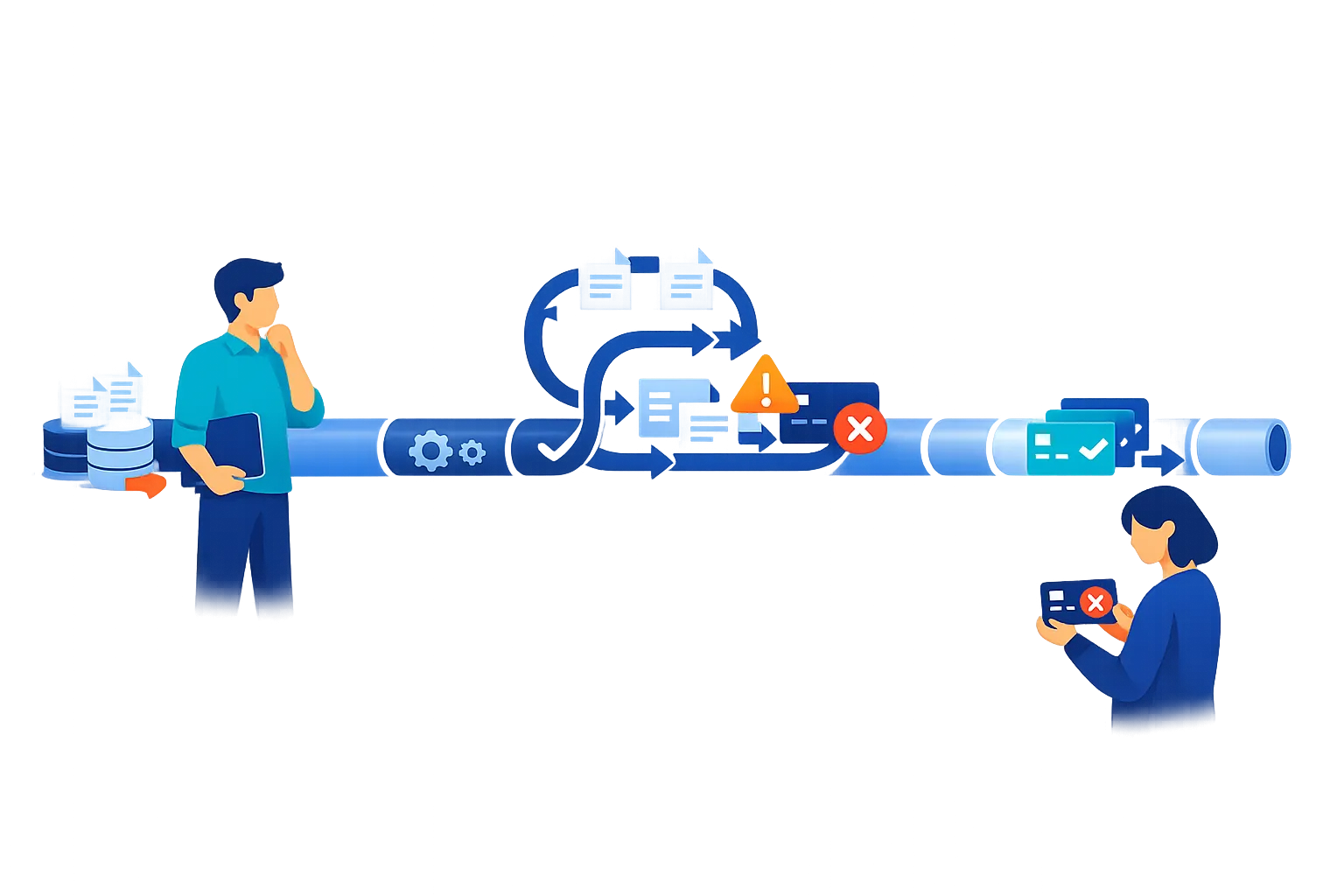
Early in my career, I was working on a pipeline responsible for processing reports of potentially compromised credit cards.
A trusted third-party vendor monitored data breaches and compromise events. Whenever they identified a card that might have been exposed, they’d send us batches of affected card numbers.
Our job was straightforward.
If a card was genuinely at risk, we’d immediately:
- Block the compromised card.
- Issue a replacement.
- Start the process of delivering the new card to the customer.
It was designed to protect customers before fraud could happen.
Done well, customers would barely notice.
Done poorly…
…customers could suddenly find themselves without a working card.
Everything Looked Fine
The vendor sent us data in batches.
Naturally, I implemented de-duplication so that if the same card appeared multiple times within a single batch, we’d process it only once.
The implementation seemed solid.
The tests passed.
The deployment went smoothly.
For a while, nothing appeared unusual.
As engineers often say…
“Looks good in production.”
Then the Complaints Started
A few days later, customer support started receiving calls.
People were confused.
Some had received replacement cards that simply didn’t work.
Others activated the new card successfully…
…only to discover it was already blocked.
One complaint in particular has stayed with me. I don’t remember the exact wording anymore, but it read something like this:
“I reported fraud on my old card, waited almost a week for the replacement, activated it today, and now your app says the card is blocked. I have bills due tomorrow, I can’t make any payments, and customer support is telling me yet another card is being sent. Can someone explain what’s happening?”
Reading something like that hits differently.
Because at that point, it isn’t a pipeline anymore.
It’s someone’s groceries.
Someone’s fuel.
Someone trying to pay for dinner.
Someone stranded at an airport.
Software has a way of becoming very personal, very quickly.
My First Thought Was…
Ironically…
My first instinct wasn’t to suspect my own code.
I assumed something had gone wrong downstream.
Maybe the card issuance team had made a mistake.
Maybe activation had failed.
Maybe another system had cancelled the cards accidentally.
It seemed far more likely than my pipeline being the problem.
So we started investigating those systems first.
Everything looked normal.
Which only made the mystery more frustrating.
Then We Found the Pattern
Eventually someone noticed something interesting.
The affected customers all had one thing in common.
Their information had appeared more than once in the vendor’s reports.
That’s when it clicked.
The vendor wasn’t guaranteeing that duplicate records would only exist within a batch.
The same compromised card could appear again in an entirely different batch days later.
And my pipeline treated that second appearance as a brand-new event.
From the system’s perspective, everything looked perfectly reasonable.
There was an active card.
A compromise notification had arrived.
The business rule said to block the active card and issue a replacement.
So that’s exactly what the system did.
Except…
The “active” card wasn’t the original compromised card anymore.
It was the brand-new replacement we’d just sent to the customer.
Sometimes it hadn’t even reached their mailbox yet.
We were cancelling cards before customers even had a chance to use them.
The Code Worked Exactly As Written
This is the part that’s always fascinated me.
There wasn’t a bug in the traditional sense.
The code didn’t crash.
There were no exceptions.
No failed deployments.
No red alerts.
The software behaved exactly as I had programmed it.
The problem was that I had solved the wrong version of the problem.
I had implemented de-duplication within a batch.
The business actually needed de-duplication across time.
That wasn’t a coding mistake.
It was an assumption.
And assumptions are some of the most dangerous bugs you’ll ever write.
That Incident Changed How I Debug
Of course, we fixed the pipeline.
We introduced logic to recognize whether we’d already processed a compromise event for that customer, regardless of which batch it appeared in.
But the bigger change happened in my thinking.
From that day onward, whenever I designed a system, I stopped asking only:
“What can happen?”
I also started asking:
“What assumption am I making without realizing it?”
Those questions have saved me far more often than any clever algorithm ever has.
Production Is the Best Teacher You’ll Ever Have
College assignments are wonderfully clean.
Inputs follow specifications.
Edge cases are listed.
The dataset behaves exactly as the assignment expects.
Production systems are nothing like that.
Real vendors have inconsistencies.
Real customers behave unpredictably.
Real processes evolve over time.
And every assumption you quietly make eventually meets reality.
Sometimes you get lucky.
Sometimes a customer receives an already-cancelled credit card.
Ownership Begins After the Incident
Every engineer will eventually ship something that causes an incident.
What defines your career isn’t whether that happens.
It’s what you do next.
Do you become defensive?
Do you look for someone else to blame?
Or do you understand the impact, own the mistake, fix it properly, and make sure the lesson stays with you long after the code changes have been deployed?
That’s the part no university assignment teaches.
Looking Back
Years later, I barely remember the implementation details of that pipeline.
I don’t remember every function I wrote.
I don’t remember every optimization.
What I remember is reading that customer complaint and realizing that somewhere behind every production system is a real person trying to get through an ordinary day.
That realization permanently changed the way I build software.
Not because I became afraid of making mistakes.
But because I finally understood who lives with the consequences when I do.
Every engineer eventually ships a bug.
The bugs you remember aren’t the ones that break your code—they’re the ones that inconvenience someone you’ve never met.
That’s the day software stops feeling like code, and starts feeling like responsibility.